
 today deals
 special offer


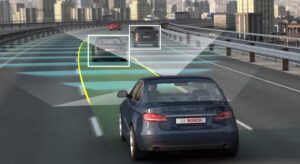
If you’ve been shopping for a newer car, you’ve probably seen the term ADAS on the features list. It sounds technical, but the idea is actually quite simple.
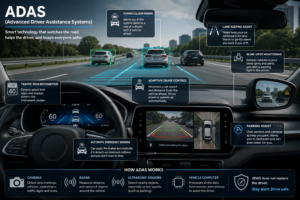
ADAS stands for Advanced Driver Assistance Systems. These are smart safety features that use cameras, radar, sensors, and computers to help you drive more safely.
Think of ADAS as an extra pair of eyes helping you on the road. It can warn you about potential dangers, help you stay in your lane, keep a safe distance from the vehicle ahead, and in some situations even apply the brakes.
How Does ADAS Work?
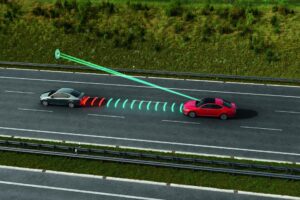
ADAS uses several technologies to understand what is happening around your vehicle.
Depending on the car, it may use:
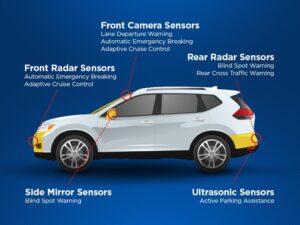
- Cameras to see road markings, vehicles, pedestrians, and traffic signs.
- Radar to detect vehicles and objects around the car and estimate their distance and speed.
- Ultrasonic sensors to detect nearby objects, particularly when parking.
- Computer software to process all this information and decide when to warn or assist the driver.
For example, if you are driving toward another vehicle too quickly, the system may warn you. If you don’t react, some cars can automatically apply the brakes.
In simple terms, the car is constantly watching what’s happening around it and helping you respond when necessary.
Common ADAS Features Explained in Simple English
Not every car has every ADAS feature. The technology varies between manufacturers and models.
1. Lane Keeping Assist
Have you ever become distracted for a moment and started drifting toward another lane?
Lane Keeping Assist can detect the road markings and may gently steer the car back toward the centre of the lane.
Some systems only warn you, while others can actually provide steering assistance.
2. Blind-Spot Monitoring
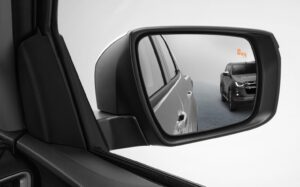
Your mirrors cannot show you everything around your vehicle. There can be an area beside the car that you cannot easily see.
Blind-Spot Monitoring watches these areas and can warn you when another vehicle is there.
For example, you might see a small warning light in your side mirror when another car is sitting in your blind spot.
This can be especially useful when changing lanes on busy roads.
3. Forward Collision Warning
Forward Collision Warning looks at the road ahead and can alert you if you’re getting too close to another vehicle or obstacle.
Imagine traffic suddenly slowing down in front of you. The system can warn you that a collision may be approaching.
The important thing to remember is that a warning is not a guarantee that an accident will be prevented. You still need to react.
4. Automatic Emergency Braking
This is one of the most useful ADAS features.
Automatic Emergency Braking (AEB) can apply the brakes if the vehicle detects an imminent collision and the driver doesn’t react quickly enough.
Depending on the vehicle and system, AEB may help respond to vehicles, pedestrians, cyclists, or other obstacles.
It is designed to help avoid a crash or reduce the severity of one.
5. Adaptive Cruise Control
Traditional cruise control allows you to set a speed and lets the car maintain it.
Adaptive Cruise Control (ACC) goes a step further.
It can monitor the vehicle ahead and automatically adjust your speed to maintain a selected following distance.
For example, if you set your car to 70 mph but traffic ahead slows to 60 mph, the system may slow your vehicle down. When traffic clears, it can accelerate again, depending on the system.
This can make long highway journeys much less tiring.
6. Parking Assist
Parking can be stressful, especially in tight spaces.
Parking Assist uses cameras and sensors to help you understand how close your car is to other vehicles, walls, or objects.
Some advanced systems can even control the steering while you control the pedals and gear selection. Certain vehicles can perform parts of the parking manoeuvre automatically.
However, you should always remain alert and check your surroundings.
Is ADAS the Same as Self-Driving?
No.
This is one of the biggest misunderstandings about ADAS.
ADAS is designed to assist the driver, not replace the driver.
Even when a vehicle can steer, brake, accelerate, or maintain its position on the road, the driver may still be required to monitor the road and remain ready to take control.
Think about it this way:
ADAS is a helper—not a replacement for the driver.
You are still responsible for driving safely.
Why Is ADAS Important?
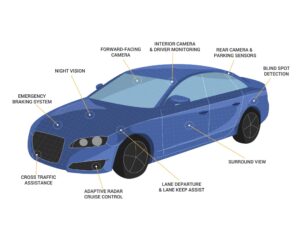
The biggest benefit of ADAS is that it can provide additional assistance when something goes wrong or when the driver misses something.
It can potentially:
- Help reduce the risk of certain crashes
- Warn drivers about hazards
- Help maintain a safe following distance
- Reduce some of the stress of highway driving
- Make parking easier
- Assist drivers when they accidentally drift from their lane
However, ADAS is not perfect. Cameras and sensors can be affected by poor weather, dirt, snow, glare, damaged sensors, or unclear road markings.
That’s why drivers should never depend entirely on these systems.
Do All Cars Have ADAS?
No.
ADAS has become increasingly common, particularly on newer vehicles, but the exact features available depend on the make, model, year, trim level, and market.
Two cars from the same manufacturer can have completely different ADAS packages.
So, if you’re buying a used car, don’t simply assume it has every safety feature because it is a newer model.
Check the actual specifications of the particular vehicle.
What Should You Check When Buying a Used Car With ADAS?
If you’re buying a used car equipped with ADAS, there are a few things worth checking.
Check the warning lights
Make sure there aren’t persistent warning messages relating to cameras, radar, sensors, or driver-assistance systems.
Check the windshield
Many ADAS cameras are mounted around the windshield area. A replacement windshield that isn’t correctly installed or calibrated can affect certain systems.
Check the bumpers
Radar and parking sensors can sometimes be located in or around the bumpers. Previous accident repairs may affect their operation.
Ask about calibration
If the vehicle has been involved in an accident or had certain components replaced, some ADAS systems may require professional calibration.
Test the features safely
Don’t deliberately create a dangerous situation to test emergency braking or collision warnings. Instead, check the vehicle’s menus, warning indicators, service records, and have the system inspected by a qualified professional when necessary.
ADAS: The Bottom Line
ADAS might sound like complicated technology, but the basic idea is easy to understand.
It is technology designed to help you drive more safely.
From blind-spot warnings and lane assistance to automatic emergency braking and adaptive cruise control, these systems can act as an extra layer of protection while you’re driving.
But remember: ADAS does not make a car crash-proof, and it doesn’t make the driver unnecessary.
The safest approach is still simple:
Pay attention, follow the road rules, and treat ADAS as an assistant—not an autopilot.
The next time you see “ADAS” on a car’s specification sheet, you’ll know exactly what it means.





Leave a Reply