
 today deals
 special offer


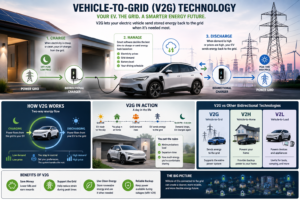
Electric vehicles (EVs) are changing more than just the way we drive. As EV adoption grows, a new technology called Vehicle-to-Grid (V2G) could allow your electric car to do something surprisingly useful: send electricity back to the power grid.
Instead of an EV only taking electricity from the grid to charge its battery, V2G technology can allow the vehicle to store electricity and send some of it back when it is needed.
But how exactly does it work, and could your electric car eventually help reduce your electricity bill?
Let’s break it down in simple terms.
What Does Vehicle-to-Grid (V2G) Mean?
Vehicle-to-Grid (V2G) is a technology that allows a compatible electric vehicle to communicate with the electricity grid and send stored energy from its battery back into the grid.
Normally, electricity flows in one direction:
Power grid → EV charger → EV battery
With V2G, electricity can flow in both directions:
Power grid ↔ EV battery
Think of a V2G-equipped electric car as a large rechargeable battery on wheels.
When electricity is cheap or plentiful, the vehicle can charge its battery. When the grid needs additional electricity, the car can potentially send some of that stored energy back.
How Does V2G Work?
V2G requires several components to work together.
1. A Compatible Electric Vehicle
Not every EV supports V2G. The vehicle must have the necessary hardware and software to allow electricity to flow from its battery back toward the grid.
2. A Bidirectional Charger
A normal EV charger generally sends electricity into the vehicle.
A bidirectional charger can do both:
- Charge the EV battery
- Send electricity from the battery back out
This two-way capability is one of the key parts of V2G technology.
3. Communication With the Grid
The vehicle, charger and electricity provider need to communicate.
This allows the system to determine things such as:
- When electricity demand is high
- When electricity is cheaper
- How much energy the EV can provide
- When the vehicle needs to be fully charged
- How much electricity should be returned to the grid
4. Smart Energy Management
Software manages the process automatically.
For example, imagine you arrive home at 6 p.m. with your EV battery at 70%.
You plug the car in and tell the system that you need 60% battery remaining by 7 a.m. the next morning.
The system could potentially use some of the available battery energy during periods of high grid demand, then recharge the vehicle later when electricity demand is lower.
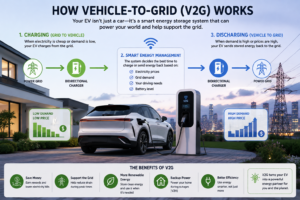
A Simple Example of V2G
Imagine an EV owner comes home from work at 6 p.m.
At this time, millions of people may be using electricity for cooking, heating, air conditioning, lighting and other activities.
Electricity demand can therefore be relatively high.
Instead of every EV simply charging immediately, a V2G system could potentially:
6:00 p.m. — EV plugged in
↓
6:30 p.m. — Grid demand increases
↓
EV temporarily sends some stored electricity to the grid
↓
10:00 p.m. — Electricity demand decreases
↓
EV begins charging again
↓
7:00 a.m. — EV is ready for the owner’s commute
The idea is to use EV batteries intelligently without leaving the owner without enough energy for their next trip.
What Are the Benefits of V2G?
V2G technology could provide benefits for both EV owners and electricity providers.
Lower Electricity Costs
If electricity prices vary throughout the day, an intelligent V2G system could charge the vehicle when electricity is cheaper.
In some markets, owners may also potentially receive compensation for providing energy or grid services.
The exact financial benefit depends heavily on the electricity market, utility company and local regulations.
Support the Electricity Grid
Large numbers of EVs could become a valuable source of stored energy.
Instead of building enough generation capacity to handle every short period of extremely high demand, utilities could potentially use connected EV batteries to help balance the system.
Better Use of Renewable Energy
Solar and wind power don’t always produce electricity when people need it most.
For example, solar panels can produce large amounts of electricity during the day, while electricity demand may remain high later in the evening.
EV batteries could potentially store some of that energy and make it available later.
Reduce Pressure During Peak Demand
During periods when electricity demand suddenly increases, connected EVs could potentially provide electricity to the grid.
This could help utilities manage short-term demand spikes.
Can V2G Save EV Owners Money?
Potentially, yes — but it depends on where you live and how the V2G program is structured.
An EV owner could potentially benefit through:
- Lower-cost charging
- Payments from an electricity provider
- Demand-response incentives
- Other grid-service programs
However, V2G isn’t automatically a money-saving technology for every EV owner.
The vehicle must be compatible, the charging equipment must support bidirectional power flow, and a suitable utility or energy program needs to be available.
What Is the Difference Between V2G, V2H and V2L?
You may also hear several similar terms when researching bidirectional charging.
V2G — Vehicle-to-Grid
The vehicle sends electricity back to the electricity grid.
EV ↔ Grid
V2H — Vehicle-to-Home
The EV can supply electricity to your house.
EV ↔ Home
For example, the vehicle could potentially provide backup power during a power outage if the necessary equipment and system are installed.
V2L — Vehicle-to-Load
The EV supplies electricity directly to electrical devices or appliances.
EV → Devices
Depending on the vehicle, V2L can be used to power things such as tools, camping equipment or other electrical appliances.
The important difference is where the electricity goes.
| Technology | Where the electricity goes |
|---|---|
| V2G | Electricity grid |
| V2H | Home |
| V2L | Electrical devices |
| Normal charging | EV battery |
Is V2G Bad for an EV Battery?
This is one of the biggest questions EV owners have.
Repeatedly charging and discharging a battery contributes to battery cycling, so it is reasonable to ask whether V2G could accelerate battery degradation.
The answer isn’t simply “yes” or “no.”
Battery degradation depends on factors such as:
- Charging and discharging levels
- Battery temperature
- Charging speed
- Depth of discharge
- Battery chemistry
- How frequently the battery is cycled
- How the vehicle’s battery-management system controls the process
A well-designed V2G system can be programmed to operate within specific battery limits.
However, the long-term impact of frequent V2G use remains an important consideration for vehicle owners, manufacturers and energy providers.
What Are the Challenges of V2G?
Despite its potential, V2G still faces several challenges.
Limited Vehicle Compatibility
Not every electric vehicle supports bidirectional charging.
Charging Equipment Can Be Expensive
V2G usually requires specialized bidirectional charging equipment rather than a basic home charger.
Utility Support Is Required
Having a V2G-capable EV doesn’t necessarily mean you can immediately send electricity to the grid.
Local utility rules, grid requirements and available programs can determine whether V2G is actually possible.
Battery Wear
More frequent battery cycling may have an impact on battery life, although the actual effect depends on how the system is used.
Regulations and Standards
V2G involves vehicles, chargers, electricity providers and the power grid. Coordinating all of these systems can be complicated.
Could Your Car Become a Home Battery?
This is where V2G becomes particularly interesting.
Imagine millions of EVs parked at homes, workplaces and charging stations for several hours every day.
Those vehicles are essentially large batteries that spend much of their time sitting still.
If connected to the right charging infrastructure, some of that stored energy could potentially be used to support homes or the wider electricity system.
Instead of thinking of an EV as simply a vehicle that consumes electricity, V2G encourages us to think of it as:
A car + a battery + an energy resource.
Is V2G the Future of Electric Cars?
V2G has significant potential, particularly as more electric vehicles enter the market and renewable energy becomes a larger part of electricity generation.
However, widespread V2G adoption will depend on several factors, including:
- More V2G-compatible EVs
- More affordable bidirectional chargers
- Utility participation
- Clear regulations
- Better charging infrastructure
- Consumer incentives
- Battery-management improvements
For EV owners, the biggest change could be that their vehicle eventually becomes more than a means of transportation.
It could also become an important part of the energy system.
Final Thoughts
Vehicle-to-Grid (V2G) allows compatible electric vehicles to potentially send stored battery energy back to the electricity grid.
In simple terms, your EV could charge when electricity is available and inexpensive, then provide some of that stored energy when the grid needs it.
The technology could help support renewable energy, manage peak electricity demand and potentially create new financial opportunities for EV owners.
V2G is still developing, and it isn’t available in the same way everywhere. But as electric vehicles become more common, the idea of using millions of parked EVs as a flexible energy resource could become increasingly important.
Your next EV might not just take power from the grid — it could help power it, too.



Leave a Reply